
Dating and Marriage in Egypt: Choosing a Path That Can Last
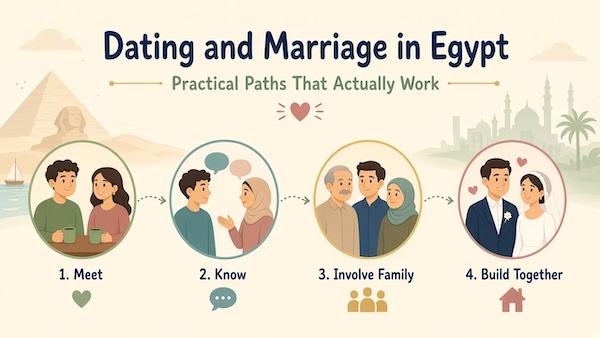
Dating in Egypt is rarely a private two-person project. Families, faith, reputation, money, and housing all shape who people meet and how quickly a relationship becomes serious. There is no single best method for everyone. The useful choice is a path that matches your values, your family's expectations, and what Egyptian law and community life require for a stable, recognized marriage.
How courtship usually works
In many households, especially outside very liberal circles, dating is expected to move toward marriage rather than stay open-ended. Ambiguity lasts less long than in some Western settings. If two people keep meeting with no discussion of intention, relatives often start asking questions, and the relationship can stall under that pressure.
Urban professionals in Cairo, Giza, and Alexandria may meet through work, university, friends, or apps, then introduce families later. In more conservative homes, the family introduction comes earlier, sometimes before the couple has spent much unsupervised time together. Neither pattern is automatically healthier. What matters is whether both people share the same timeline and whether families will support the match once it becomes public.
Meeting people without wasting years
The most reliable introductions still come through people who know both sides: relatives, colleagues, neighbors, and friends from mosque, church, or campus. Those introductions carry social information a profile cannot show: work stability, family reputation, and whether someone has a history of broken engagements.
Apps and social media can widen a small circle. They work better as a first filter than as a complete courtship. Photos and chat chemistry do not reveal how a person treats parents, money, or conflict. If you use an app, move fairly soon to a video call, then a public meeting, then a clear talk about marriage. Endless messaging with no plan is a common way to lose time.
Shared activities are underrated: classes, sports clubs, volunteer work, professional associations, and community events. They show habits, not just opinions. Punctuality, respect toward staff, and calm under small stress tell you more than a speech about "family values."
Do not confuse adult media with a marriage search
Egyptian internet life includes a large audience for adult video. That habit is not a courtship method. People who spend evenings browsing سكس مصري are consuming entertainment, not learning how families negotiate housing, gold, or a wedding timeline. Using explicit clips as a script for real dates creates false expectations about consent, privacy, and what a partner will accept in ordinary daily life.
Be equally cautious when a chat turns into a request for films or links. Someone who keeps sending سكس مصري جديد instead of discussing work, faith, children, and where you would live is not building a household. Treat that as a signal to stop, not as modern dating. A serious introduction can survive awkwardness. It cannot survive a partner who wants secrecy, images, or illegal pressure rather than a public plan.
Compatibility that actually matters
Attraction starts many relationships; daily life decides whether they last. A few questions deserve early honesty.
Religion and practice: Interfaith marriage is legally and socially complicated. Even within the same faith, differences in prayer, dress, gender mixing, and holidays become daily negotiations. Hoping these will "sort themselves out later" is a frequent cause of broken engagements.
Family involvement: Ask how often each person expects to visit parents, whether newlyweds will live with relatives, and who decides major issues. Kindness toward you paired with hostility or total dependence on family will enter the home.
Money and housing: Marriage often involves furniture, gold, an apartment, and ceremony costs. Incomes need not match. You do need a realistic plan: who pays for what, whether both will work, and whether debt is being hidden. Hidden strain is more destructive than a modest start.
Children and roles: Discuss work after children, housework, and how sons and daughters should be raised. "We'll be modern" or "we'll be traditional" is not a plan.
Location: Someone willing to live only in one neighborhood, or only abroad, is not compatible with a person rooted elsewhere. Say migration hopes early.
Engagement as a test, not only a party
A formal engagement, or khutuba, is useful when families know about it and both sides can still exit. Watch consistency: Are promises kept? Does the person speak respectfully about your family in private? Do they pressure you sexually, financially, or socially in ways they denied before relatives met?
Meet in settings that allow conversation. If every gathering is a large dinner, you will not see how the two of you solve problems. If every meeting is secret, you will not see how the relationship survives public responsibility.
If serious doubts appear, ending an engagement is usually less damaging than forcing a wedding to avoid gossip. Families may push for speed. Speed is reasonable when documents and housing are ready. It is dangerous when it is used to prevent questions.
The legal side, in plain terms
A marriage that is only social, or only a private paper, can leave a spouse — especially a woman — with weak protection around housing, children, and money. People who want a recognized marriage generally need official civil registration plus the religious ceremony that matches their community.
Requirements can include identification, medical tests, and paperwork that varies by religion and office. Coptic and Muslim procedures differ. Foreign documents, previous divorces, and mixed-nationality couples add steps. Treat online summaries as orientation only and confirm details with the relevant office or a qualified lawyer. Do not rely on "we will register later."
Unofficial arrangements may look faster or cheaper. They often create later disputes about legitimacy, inheritance, and papers for children. If someone refuses a clear, registered marriage without a specific lawful reason, treat that as a warning.
A sequence that works for many couples
- Meet through a channel you can explain to your family later.
- Talk early about faith, work, children, housing, and city.
- Introduce families before money is spent on a large celebration.
- Agree on costs in writing between families if that is your custom.
- Finish medical and legal steps before booking irreversible venues.
- Keep one trusted relative informed so you are not isolated if problems appear.
This is not romantic theater. It reduces two common failures: marrying a stranger, and dating for years with no path to a household.
What "best option" means
The best option to marry in Egypt is a public, registered partnership between two adults who have seen each other's character, accepted each other's families at a workable level, and agreed on money and religion without coercion. For some people that starts with a family introduction. For others it starts at work or online and becomes formal later. The method is secondary. Clarity, legality, and compatible daily expectations are not.
Do not invest in a wedding aesthetic before you have invested in documents, housing reality, and hard conversations. A modest marriage with aligned lives is more durable than a large party built on assumptions.
Other great posts in 'None' topic
- 29 Sep 2026 - What I Like About Swinger Amateur Porn
- 22 Sep 2026 - FFM Threesomes In Amateur Versus Professional Porn
- 22 Sep 2026 - A Special Surprise For My Husband In New York
- 09 Sep 2026 - Porn That’s Better On Computer (My Preferences)
- 21 Aug 2026 - The profile that looked perfect